What Do the Numbers Say?
In their book In Person, published in 2026, economists Natalia Emanuel and Emma Harrington examine the real hidden costs of remote work. The book was also featured in The Economist.
More tasks done, lower quality. People may get more tasks done at home, while the quality of the work can suffer. According to a 2025 study, large banks that called their analysts back to the office for a few days a week saw their forecasts become 15% more accurate than at banks operating fully remotely.
Mentoring falls by the wayside. Experienced developers write more code at home, but pay less attention to reviewing the work of their younger colleagues.
Graduates pay the price. According to an LSE–Oxford study, remote work is more to blame than AI for the difficulties young people face in finding a job. Companies are less willing to hire people whose work they cannot see first-hand.
Yet this is not the most important finding.
What matters is not how many days someone spends in the office, but whether they are there at the same time as their key colleagues.
This Is Nothing New for Us
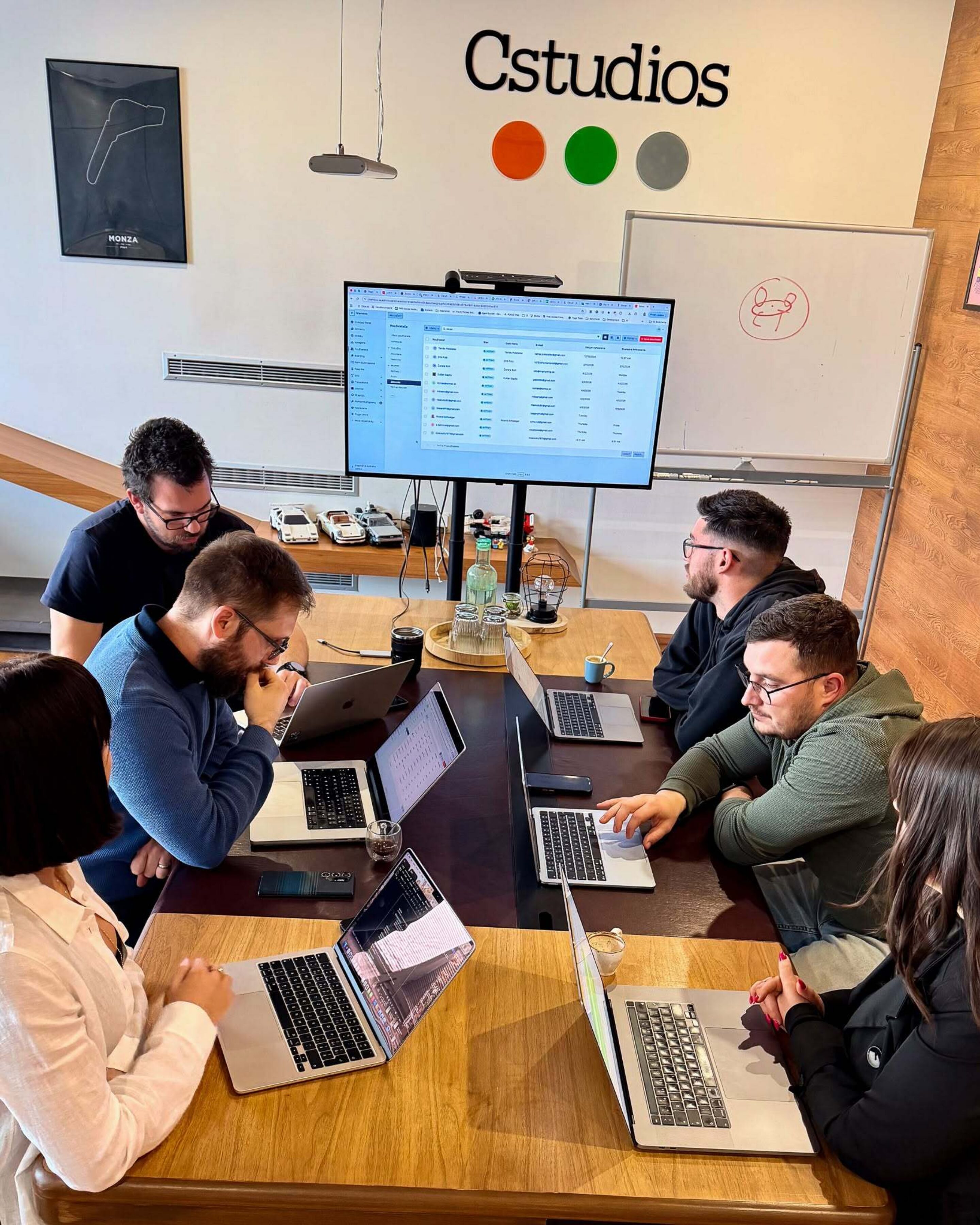
Cstudios started out in a basement in 2007, with three people around a single desk. The ideas were born right where we sat side by side.
Today there are 19 of us, and we offer the option to work from home too. On Tuesdays and Thursdays, however, everyone is in the office. The whole team, no exceptions.
The marketing team works in the office every day and brainstorms together. Our project and account managers are also in every day. From Monday to Friday, they have coffee together in the morning and go over the projects in progress.
Why do we stick to this?
A website is never the work of a single person. A designer, a developer, a copywriter and a marketer sitting at one table reach common ground faster than through ten emails.
And the best ideas are not necessarily born in meetings. Often they come over coffee, from half-finished sentences, when someone glances at a colleague’s screen.
That is also how juniors learn. They see how an experienced colleague makes decisions, and they can ask questions right away.
We did not learn this on a single project, but over the years, through working together.
This is how every website and marketing campaign of ours is made. The designer, the developer and the marketer think about the task together right from the start.
With a new website, the structure, the design and the code take shape together. With a campaign, the creative idea, the photos, the video and the ads all grow out of the same shared brainstorming.
This way, the individual parts are not created independently of each other, but as part of a single, unified concept.
It shows in both the quality of the end result and the speed of the work.
What’s in It for the Client?
We take the same approach when working with our clients.
Before we design a website, we visit them in person. We look at their production processes, ask questions and get to know how the business works.
A company’s day-to-day operations and real needs cannot always be understood over a video call.
What does all this mean for the client?
- Faster decisions, because the team discusses things together, in one place.
- More thorough quality control, because reviewing the work is part of the shared process.
- Better solutions that come from thinking together, not merely from a to-do logged in a task management system.
Not Dogma, but Balance
We don’t think everyone needs to sit in the office every day. For many people, such as parents of young children, remote work is a real help. Research also points to the benefits of hybrid working.
The key is finding the right rhythm. There should be days when the team truly works together.
Flexible desk use, so-called hot-desking, where everyone sits somewhere different at different times, can make regular in-person collaboration harder.
And there is one more important point: if a leader wants to reap the benefits of office culture, they need to be there too.
Summary
Remote work is here to stay. But its cost does not always show up in the reports.
Missed ideas, more superficial reviews, graduates who develop more slowly. Consequences that are hard to express in numbers, yet can affect a team’s performance.
We believe in balance. In flexibility, but also in fixed days together.
Because a great website or marketing campaign often starts with a simple conversation.
Curious how we work? Come and meet us in person!
Sources: Natalia Emanuel and Emma Harrington: In Person (Crown Currency / Penguin Life, 2026); The Economist, 5 November 2026.
https://www.economist.com/culture/2026/11/05/is-it-time-to-end-the-era-of-remote-work